
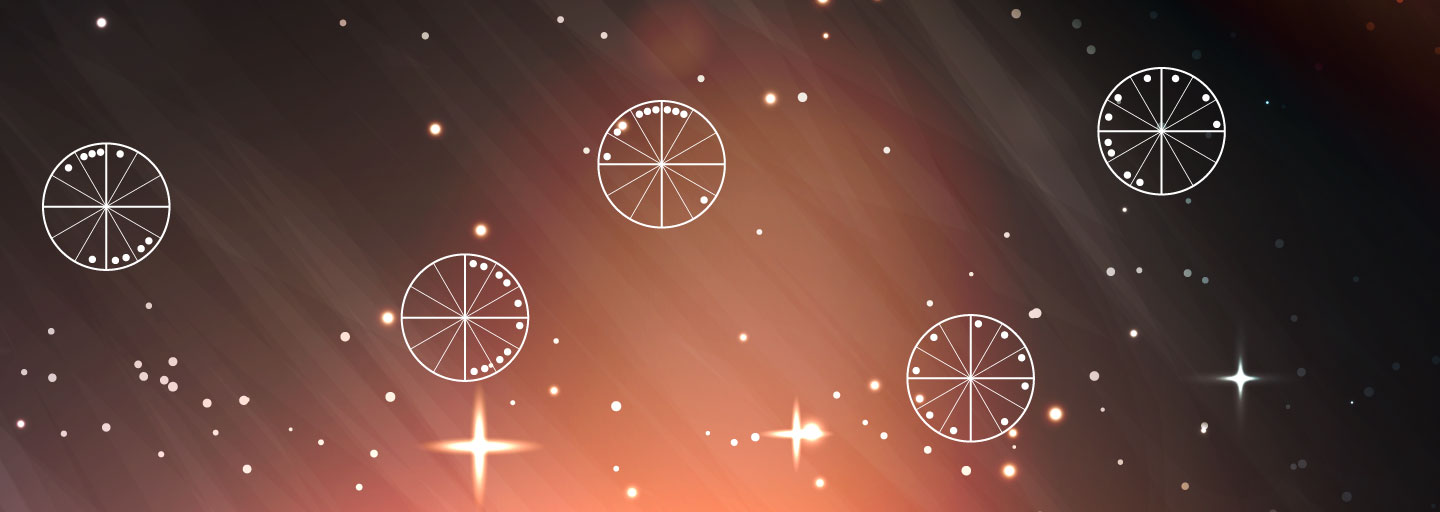
I am adding to this site the chart patterns that were first identified by Marc Edmund Jones here, as well as those later added by Carl Jansky (Fan Shape) and March/McEvers (Wheelbarrow). I am using the descriptions found on the Astro Dienst website. This will allow people access to these details without my having to add them to the appendix of my book. I will always be considering the Bundle and Bucket patterns in overviews. The Bowl pattern is similar to one of the aspect figures that I use, called The Cradle Figure. The other Chart Patterns can definitely have value when discussion overall motivation and energy focus in charts. Please do not confuse these Chart Patterns with Aspect Figures. My book discusses the 45 different aspect figures in detail with examples in Inner Charts, Outer Charts or in instances when the same aspect figure is found in both charts. My book will be published soon.
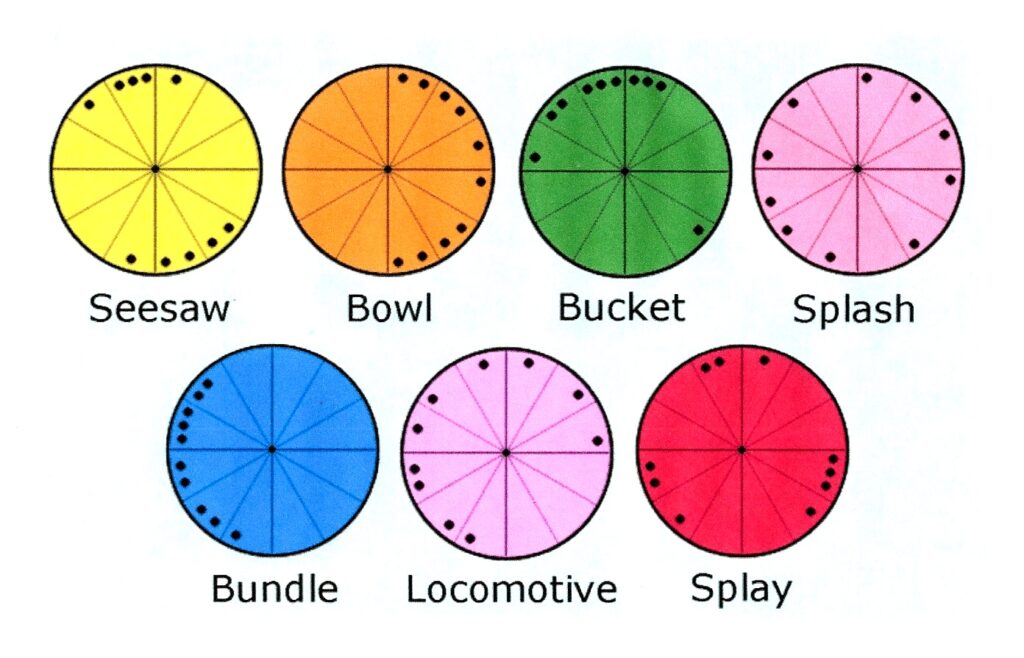
Chart interpretation is a complex matter, and there are several ways to go about it. Before going into detailed analysis of individual chart factors, it can be helpful to get a general idea of the general tendencies in a horoscope. There are several methods to do this, e.g. checking the balance of the elements (fire, earth, air, water) or the qualities (cardinal, fixed, mutable), as well as the hemispheres and quadrants.
Another way of finding out about general tendencies in a chart is the analysis of chart patterns. The American astrologer Marc Edmund Jones (1888-1980) identified seven chart patterns by observing in which way the ten planets (without axes, sensitive points or other chart factors) are grouped or spread within a horoscope.
Some patterns are hard to distinguish in practice, e.g. the Seesaw and the Splay. Except for the Splash pattern, Marc E. Jones described the derivative of the Splay and Locomotive patterns as being based on the threefold principle and the others on the two-four pattern.
Threefold patterns
The temperament types based on the threefold principle (the Bundle, Locomotive and Splay) give a greater degree of emphasis to the inner drive within the person taking control and emerging into manifestation.
Bundle shape
All of the planets in the horoscope appear within the span of a trine or 120° or 4 signs of the zodiac. Normally a bundle would appear in four or fewer adjacent signs or houses.
This formation can give the individual a tremendous focus in life, enabling them to accomplish much in their area of concentration. The high concentration of planets produces a person who is equally intense and unrelenting in pursuit of personal interests.
With this emphasis, however, often comes a lack of widespread interests or a more panoramic view of life. Perspective and understanding of others is limited, and it is difficult for this person to share their lives with anyone.
The best course of life for such a person is to enter into enterprises that require deep concentration, persistence and commitment, or to specialise in one area of expertise.
Locomotive shape
This pattern is produced when all the planets are contained within 240°; normally including eight contiguous signs or houses (although an empty sign or house is allowed.)so that a whole 120 degrees is completely unoccupied.
The planet that rises clockwise following the empty space will significantly influence the life of the person with this pattern, no matter what is indicated by the sun sign. It will act as the ‘locomotive’ of the natal chart, driving the individual to achieve goals through determined and unrelenting effort, with an exceptional drive and fund of energy at their disposal.
The individual is typically driven to achievement, in perceiving a “lack” to be filled or problem to be solved as indicated by the empty signs and houses. Such a person will often be a loner, waiting for the public to discover the truth of what they have been saying all along.
Splay shape
This type of natal chart is noteworthy because of the presence of at least two, but usually three pairs (or conjunctions) of planets randomly distributed in a ‘splay’ shape around the chart. A Splay is essentially a tripod pattern. It must have three separate segments with at least one empty sign between them. A grand trine is also very characteristic of the Splay.
A person with this pattern will have enormous talent and potential that needs deliberate attention to be developed into worthwhile skills. The person will be an individualist, with no desire for a regimented or highly organized way of life, and they will seek to avoid becoming trapped in routine.
However, there is often the difficulty that there is a lack of relevance between the different skill sets, so that the person may not derive the full benefit from them. Such a person needs to concentrate on ‘getting their act together’.
Two-four patterns
Those patterns based on the two-four pattern (the Seesaw, Bowl and Bucket) are more challenged by their conditioning and their situation to manifest their potential.
Bowl shape
In the bowl shape, all planets are located across one half of the horoscope, i.e. within 180° or six signs of the zodiac, usually bracketed by opposing signs or houses.
A person with a bowl shaped chart pattern tends to be highly focused, self-contained and have strong core values. The individual will go in search of enterprises that are meaningful, fulfilling and personally relevant. The have the greatest benefit for themselves and others at heart.
The challenge of the bowl shape is to become conscious of and integrate the qualities of the opposing hemisphere.
Bucket shape
This is similar to the bowl shape, except that one planet opposes the planets that are close together in one hemisphere. The singleton planet is called the ʹhandleʹ of the bucket and tends to be very strong, striving to dominate the other planets.
A person with a bucket shaped chart pattern has the strong desire to be an active part of mainstream society. They want to feel that they belong. However, they often want society to discover their own unique talents, rather than them trying to fit in. This person often directs their efforts towards one single purpose, wanting to achieve a goal rather than act just for their own self-preservation.
The singleton planet at the handle of the bucket will strongly influence the behaviour of the person, it will be more important in the person’s life than all the other planets. The challenge is to channel the energy wisely.
Seesaw shape
An aspect pattern composed of planets grouped together in two opposing clusters, and where the two sections of the chart on either side of these clusters are empty of planets and at least 60° or two signs wide.
As its name suggests, this produces a person who behaves like a ‘seesaw’, with their life following a pattern of two distinctly contrasting alternatives. This can indicate considerable instability between the two clusters where oppositions predominate, as the native tends to express first one side and then the other. The person can find it difficult to integrate these two sharply different parts of their life, which are often in competition with each other.
However, success produces the increased sophistication and polished, knowing demeanor of a person who is able to deal with most of life’s situations
No particular category
Splash shape
As its name suggests this pattern, or rather lack of pattern, occurs when the planets are randomly distributed around the chart in a ‘splash’. A true splash pattern should have at least seven tenanted signs or houses with no major stellia.
A person with this pattern will have diversification as their number one asset, with a universal and enriching mental outlook on life. The person will be eager to share their life and resources as universally as possible, wherever the need is greatest.
However, as with the splay pattern, there is a danger of the person scattering their energy unproductively.
NOTE: The patterns are described in more detail, for example, in Marc Edmund Jones: “The Guide to Horoscope Interpretation.”
Additional Shapes:
FAN SHAPE
Carl Jansky added another shape, the Fan Pattern. The Fan Pattern is similar to a Bundle in that it has most of the planets within a 120 degree bundle but it is also like the Bucket in having a handle that is roughly opposed to the Bundle. The Fan’s handle drives the blade whereas the Bucket’s handle supports or focuses the bucket. The handle of the Fan acts more like an opposition. In essence, the singleton of the BUNDLE is the “cause” whereas in the BUCKET the singleton is the “effect.”
WHEELBARROW SHAPE
Astrologers March & McEvers continued the research on this pattern. This pattern consists of a BUNDLE with two equi-distant handles or singletons on the opposite side. They can be as close as a sextile (60°) on one side and as far apart as a quincunx (150°) on the other side. The even or uneven placement of the handles makes a difference in how the energies are used because their job is to balance the barrow energies. You must consider the relationship between each handle and the rim planet it is closet to – the closer handle reveals emphasis of the individual’s nature The month of summer harvest. The Sun has ripened the crops and man has rested so to now have strength to reap the bounty of the earth.