
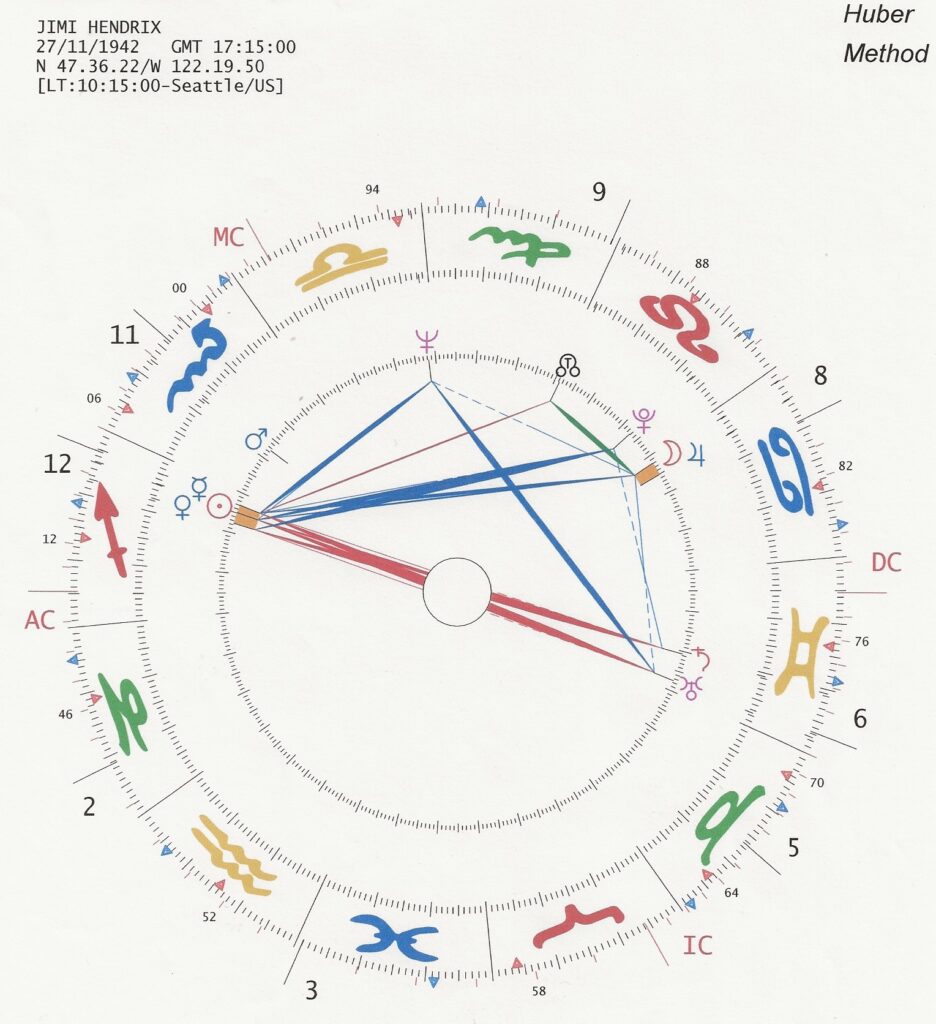
A discussion of the Inner and Outer Charts for Jimi Hendrix follows below. This is from my book where the focus is on the Cradle Figure, but there is some focus on an overview of his charts. Here are the Inner and Outer Charts:
Inner Chart:
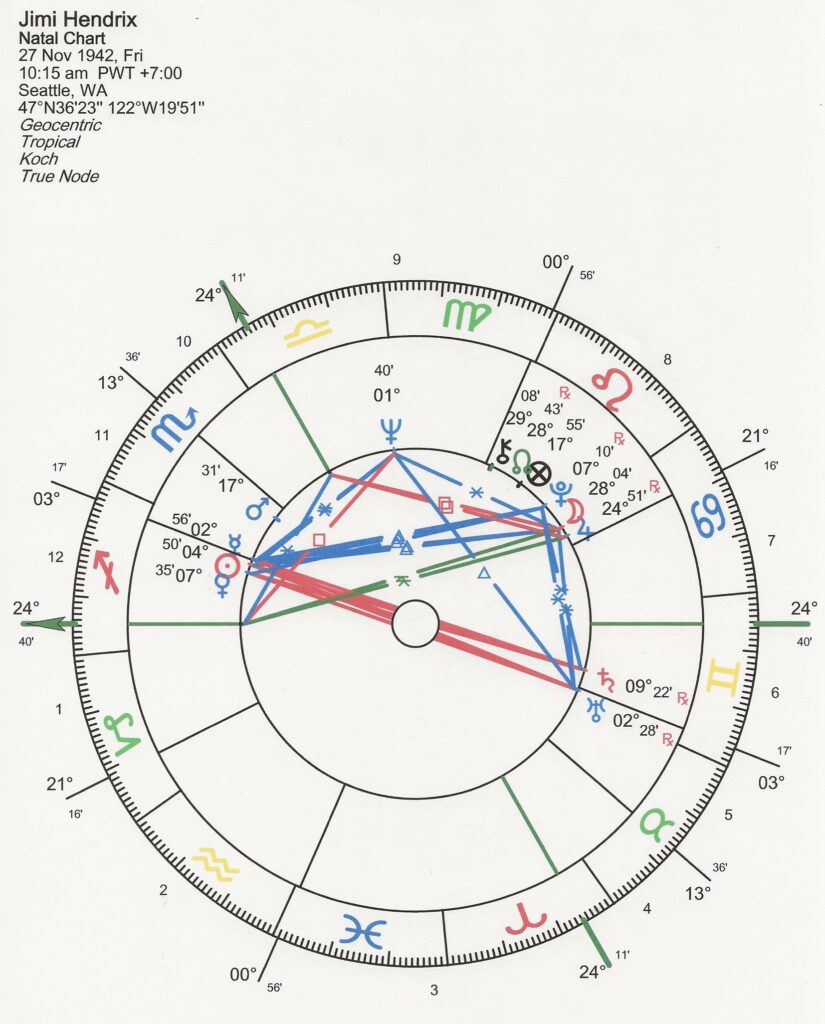
Outer Chart:
Sadly, Jimi Hendrix, as with Janis Joplin, did not live long enough to figure out how to resolve his personal issues and conflicts so as to be able to understand and rise above his own patterns of self-undoing. He was able to create and demonstrate his unique musical talents. He was unique in his lyrics and style, both with his music and with clothes. Widely recognized as one of the most creative and influential musicians of the 20th century, he pioneered the explosive possibilities of the electric guitar. Hendrix’s innovative style of combining fuzz, feedback and controlled distortion created a new musical form. Because he was unable to read music, it is nothing short of remarkable that his meteoric rise in music took place in just four short years.
The Sun Stellium is in Sagittarius opposes Uranus/Saturn in Gemini. The theme and topic of the opposition center around the mentally and physically expressive signs of Sagittarius and Gemini on the Existence 6th/12th Axis. The Sun Stellium in Sagittarius in the 12th house represents a very creative and skillful person who can use time in isolation (in his private world) to envision and construct beautifully aesthetic music that describes his mental, emotional and physical sense of self in its creative manifestation. He also sought originality in his use of his hands and mind. He created unusual types of sound and music. That Stellium also describes a person who may want to hide his fiery nature, and Jimi grew up in a tough situation which, to his credit, he did not allow to let affect his presentation of himself in his outer, musician based, world. He was very shy and introverted offstage. Saturn conjunct Uranus in Gemini in the 6th house described his unique musical style, which was the central focus of his work. He combined a unique use of his mind and hands to create music, and he used the unique Saturn discipline to teach himself how to play a guitar. He created his own musical structure and style. That Saturn helped him create a structure out of his unique format. The Uranus speaks to his flamboyant public persona. The opposition wanted to express his mental vision of his artistic expression, his unique and visionary music. This was his vision, his offering to the world which allowed him to manifest the physical structure (Saturn) of his Self (Sun) shining in its creative expression. When doing so, he was able to harness the amplified emotional need to express his feelings as shown by Moon (at home in Cancer) in the 8th house of deep emotional substance made bigger by the presence of Jupiter. Neptune offered additional sensitivity and heightened perception to his creative expression. He enjoyed being able to express the imagination and even find the glamor potential that were available with Neptune. When playing his music, he was very comfortable within the confines of the Cradle.
This 6th house Saturn/Uranus also speaks to stress that came with trying to satisfy Saturn’s demands as a performer. This created the physical exhaustion and stress. Drug and alcohol use can also result as a response to the tension involving the Existence Axis. There was bottled up tension. The personal conflicts caused by his early life experiences, and the attempt to rise above his early negative life, show the focus on the upper hemisphere in his chart. He wanted to be free, interested primarily in finding his place in his professional outer life. When he came face to face with himself in his personal life, many times the lack of connection with his cultural roots created a desire to escape which led to the use of drugs and alcohol.
Was Hendrix able to find access to the open Collective area of the chart? The blue aspected planets, Moon and Neptune, show clearly in his music specifically, offering talent and substance to the creative expression of his mental sense of self (Sun) combined with the structure of his creativity (Saturn). This shows his enjoyment and willingness to live within the upper hemisphere individuality that he created. Neptune is clearly bringing inspiration and imagination into his work and the Moon, as dispositor of the chart, conjunct expansive Jupiter, also carried strong emotional content into the work. He seemed to find either resolution of existence on the work level or acceptance of the music as an escape. I think that he found connection to the Collective with his music, finding resolution with that part of the Cradle experience.
As is always a possibility with the Cradle in the upper hemisphere, especially with no access points to the empty hemisphere, he was not grounded and had no roots. I was not able to find biographical information on how he actually dealt with the public and what his comfort level might have been on a day-to-day basis but, his comfort would be in his individuality and the public person and career thus created, not in the arms of the realities found outside that Cradle. He had a brother who he was close to, but their relationship was complicated. Leon had substance abuse issues, and actually heard about Jimi’s death on the radio while in prison. On the personal level of existence, therefore, it seems that the overly emotional Moon would succumb to the Mars ruled 4th house’s unresolved anger and disappointment, the lack of connection to any roots or family history. In this case Neptune only inflamed the sense of negative self-images when drugs were involved. That unaspected Mars was a powerhouse when being used positively but explosive when untamed negatively.
He had a learning triangle in his Outer Chart with the Ascendant tied to Neptune and the Moon which shows how he was asked to learn how to change his personal image or presentation in order to present to the world his reigning emotional needs amplified by his Neptunian mystic and glamor. He learned how to create that persona. I have included this discussion of Jimi Hendrix because of how well it describes his internal issues being translated into the outer world without any additional filters. The Outer Chart does add the effects of that learning triangle at work.
Some quotes that fit what is discussed above are:
From “Biography.com: He had a difficult childhood, sometimes living in the care of relatives or acquaintances. His mother, Lucille, was only 17 years old when Hendrix was born. She had a stormy relationship with his father, Al, and eventually left the family after the couple had two more children together, sons Leon and Joseph. Hendrix would only see his mother sporadically before her death in 1958. In many ways, music became a sanctuary for Hendrix.From Wikipedia: After returning from service, Al (his father) reunited with Lucille, but his inability to find steady work left the family impoverished. They both struggled with alcohol, and often fought when intoxicated. The violence sometimes drove Hendrix to withdraw and hide in a closet in their home. A shy and sensitive boy, he was deeply affected by his life experiences. When Hendrix drank to excess or mixed drugs with alcohol, often he became angry and violent. His friend Herbie Worthington said Hendrix “simply turned into a bastard” when he drank. According to friend Sharon Lawrence, liquor “set off a bottled-up anger, a destructive fury he almost never displayed otherwise”.